

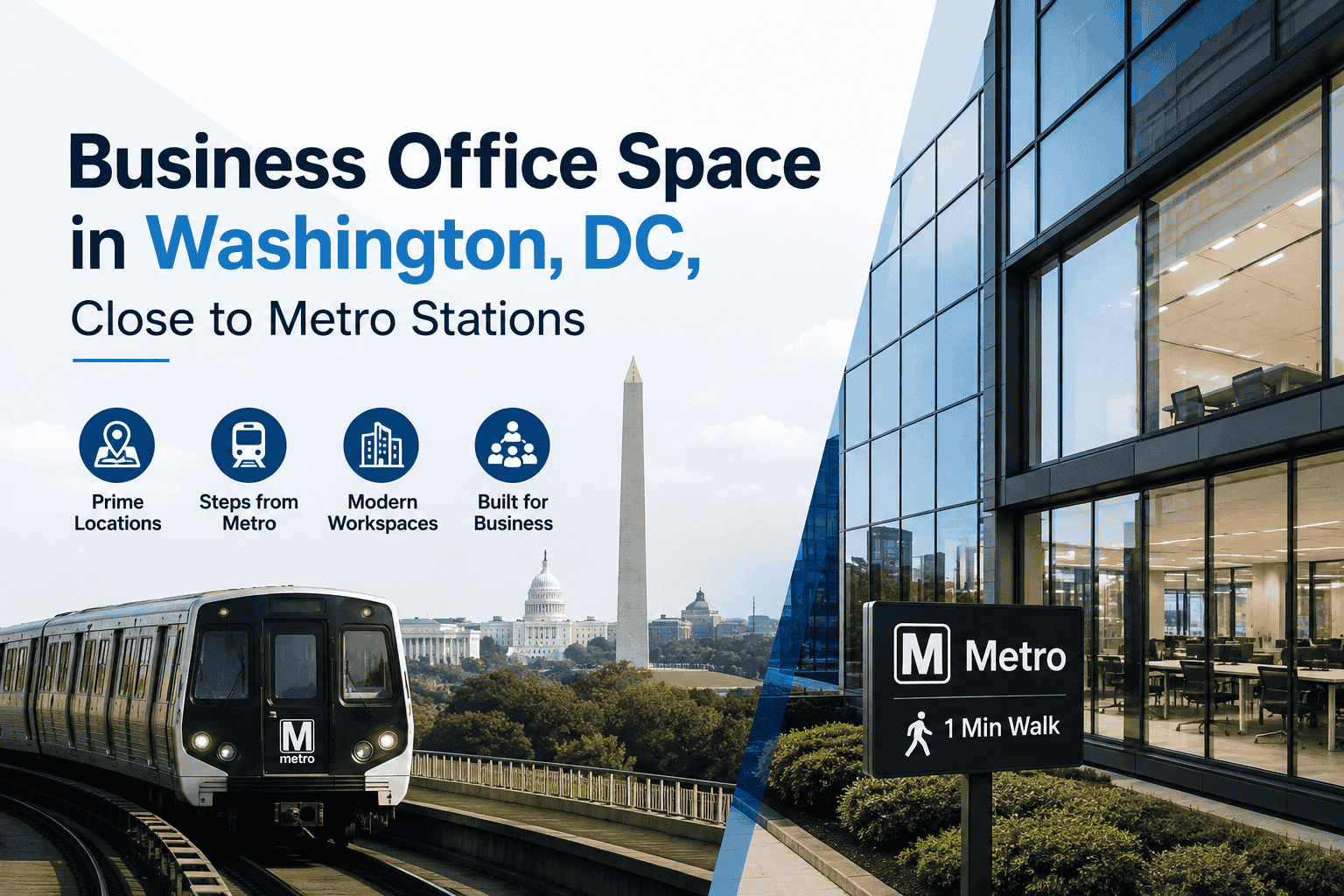
Summary: This post explains why Metro access matters when choosing office space in Washington, DC, which neighborhoods offer the strongest connections, and what to check before signing a lease near a station.
Commute time shapes whether an office actually gets used the way a business plans for it. This blog looks at which Washington, DC neighborhoods offer the strongest Metro access, what that access is worth in practice, and how to evaluate an office’s real distance from a station rather than the distance a listing claims.
Business Office Space Close to Metro: Where District Offices Puts You
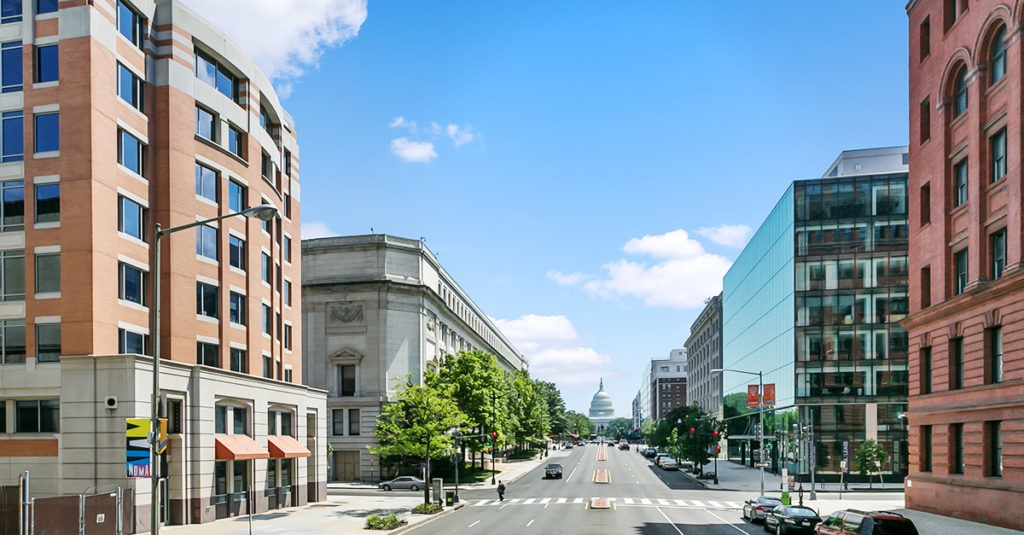
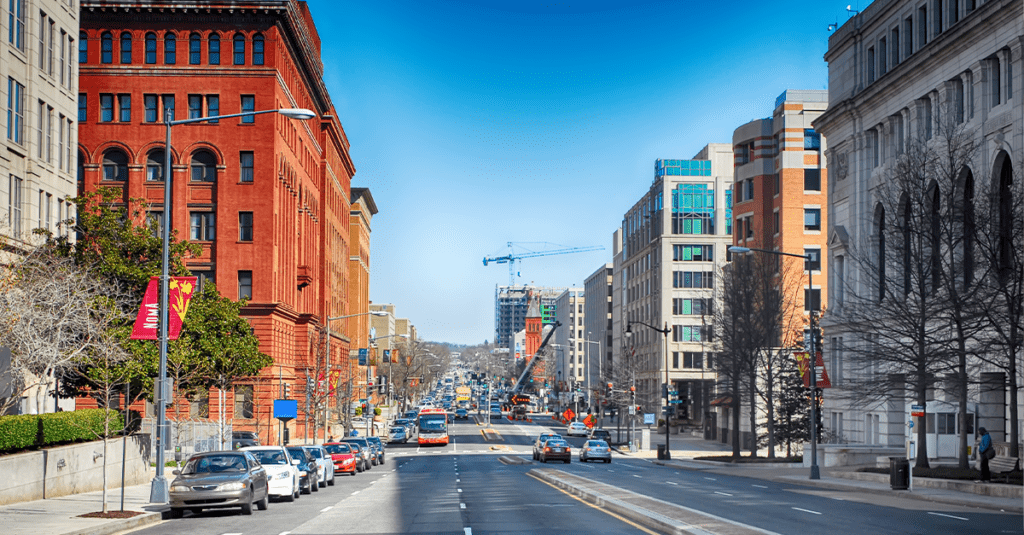
District Offices operates out of three locations, Farragut Square, Capitol Hill, and Georgetown, and the Metro access at each one looks different by design.
- Farragut Square – Two blocks from both Farragut North and Farragut West, this address puts private offices, coworking desks, and hourly meeting rooms within a five-minute walk of the Red, Blue, Orange, and Silver Lines, making it the easiest daily commute of the three for staff riding in from Maryland or Virginia.
- Capitol Hill – A short walk from Capitol South and Eastern Market on the Blue, Orange, and Silver Lines, this location offers private suites and virtual office plans for teams and consultants who need to move quickly between the office and meetings on the Hill.
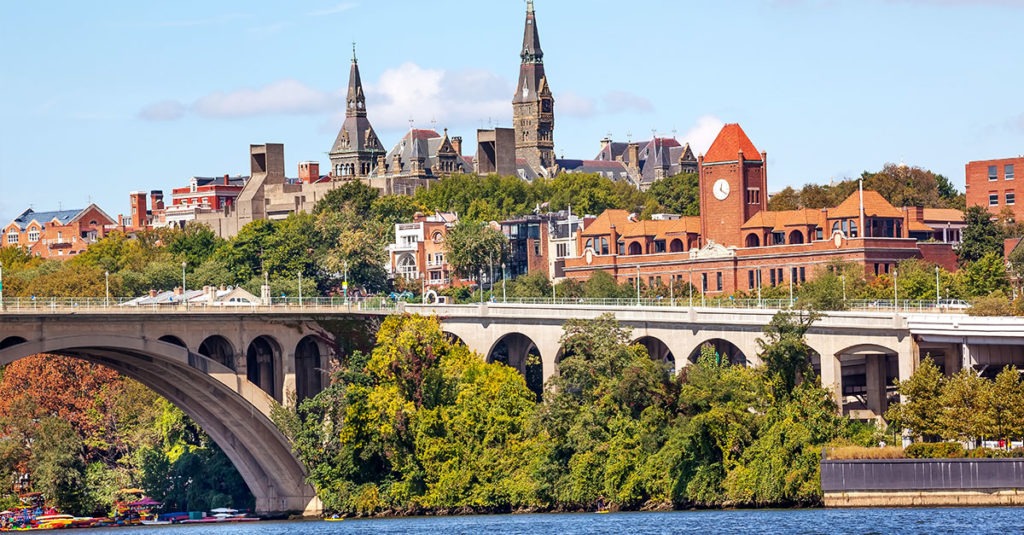
- Georgetown – Reached by a free shuttle from Foggy Bottom-GWU rather than a direct station, this location trades a rail connection for a waterfront coworking and private office setting that many teams choose specifically for its distinct, non-downtown feel.
Pro Tip: If a direct Metro connection is a hard requirement for your team, Farragut Square or Capitol Hill will serve you better than Georgetown. If neighborhood character and a distinct client experience matter more than rail access, Georgetown remains a strong option.
The rest of this post breaks down what real Metro access is worth, which stations serve which lines, and how to verify walking distance before you sign anything.
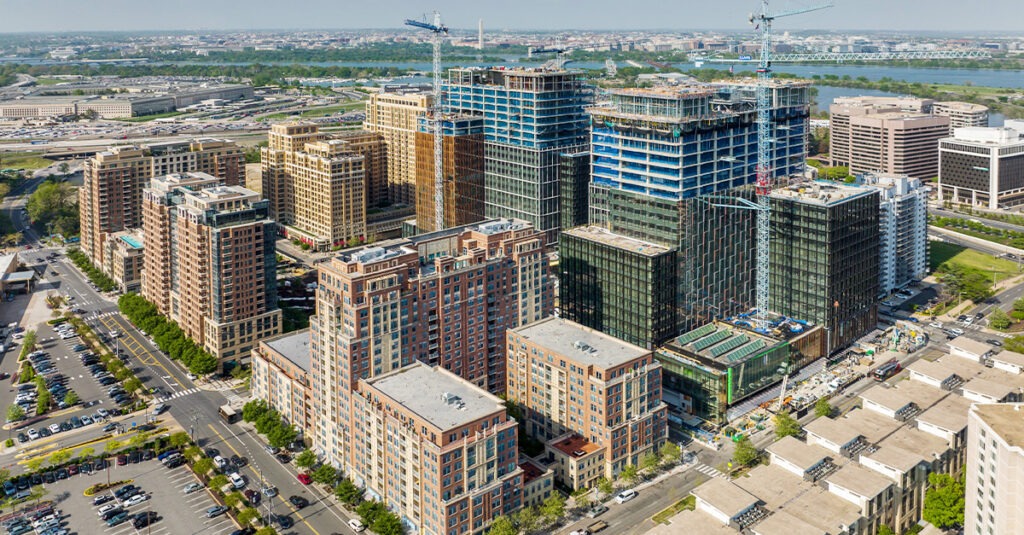
Quick Overview: Metro Center, Farragut North, Farragut West, and Capitol South sit inside some of the densest office concentrations in the region, with roughly 70 million square feet of office space packed into an area of about two-thirds of a square mile around Farragut Square, McPherson Square, and Metro Center alone.
Also Read: Workspace Solutions in Washington, DC for Startups and Small Teams
Why Metro Access Matters for Office Space
A short commute affects attendance, punctuality, and how willing staff are to come in at all. This is why Metro proximity ranks near the top of most office searches in DC, even above square footage or finish quality.
Metro access also affects client and candidate experience. A client who can walk from a station straight to your door forms a different impression than one who circles the block looking for parking, and a candidate weighing two job offers will often factor commute time into the decision without saying so directly.
Note: A location listed as “near Metro” can still mean a 12-minute walk uphill. Always confirm the actual walking route and time before assuming proximity.

DC Neighborhoods With the Strongest Metro Access
Some DC neighborhoods sit directly on top of multiple Metro lines, while others require a longer walk or a bus connection. The neighborhoods below offer the most direct access.
- Farragut Square – Served by both Farragut North (Red Line) and Farragut West (Blue, Orange, and Silver Lines), with a pedestrian tunnel option connecting the two stations. This is one of the densest office concentrations in the entire region.
- Metro Center – A major transfer point for the Red, Blue, Orange, and Silver Lines, placing it within walking distance of the broader downtown core.
- Capitol Hill – Served by Capitol South and Eastern Market, both on the Blue, Orange, and Silver Lines, giving policy-focused and legal organizations quick access to the Capitol complex.
- Georgetown – Notably, Georgetown has no direct Metro station of its own. Commuters typically rely on a shuttle connection from Foggy Bottom-GWU or Rosslyn, which is worth knowing before assuming every downtown-adjacent neighborhood has rail access.
Pro Tip: Do not assume every prestigious DC neighborhood sits on the Metro. Georgetown is the clearest example of a highly desirable business address that requires a bus or shuttle rather than a direct rail connection.
How to Judge Real Walking Distance
Listings often round distance in their own favor. Use these steps to verify before you commit:
1. Walk it yourself, at rush hour – A route that looks short on a map can include crosswalks, elevators, or hills that add real time.
2. Check both entrances – Many stations, including Farragut West, have entrances on opposite ends of a block. Confirm which entrance is closest to your specific building.
3. Confirm the line, not just the station – Two stations with the same name, like Farragut North and Farragut West, often serve completely different lines and are not directly connected underground.
4. Ask about weather protection – A short walk in the rain without any covered path can feel much longer than the distance suggests.
What to Check Before You Sign
Beyond walking distance, a few practical details determine whether Metro access actually benefits your team day to day.
- Line reliability – Some lines experience more frequent delays or single-tracking than others. Check recent service history for the specific line your team will use most.
- Building entrance hours – Confirm the building itself is accessible whenever your team’s typical Metro commute would bring them in, including early mornings or evenings.
- Bike and scooter storage – Many downtown workers combine a Metro ride with a short bike or scooter leg. Secure storage adds real value if this applies to your team.
- Alternate transit options – A location strong on Metro access but weak on parking may still create friction for clients or staff who prefer driving.
Note: If your team is hybrid, weigh Metro access against how often people are actually expected in the office. A perfect commute matters less if the space sits empty three days a week.
Also Read: Best Private Office Space in Washington, D.C. for Small Businesses
Metro Access by Line
| Metro Line | Key Downtown Stations | Neighborhoods Served |
| Red | Farragut North, Metro Center | Farragut Square, Downtown core |
| Blue/Orange/Silver | Farragut West, Metro Center, Capitol South, Eastern Market | Farragut Square, Downtown, Capitol Hill |
| Shuttle only | N/A | Georgetown (via Foggy Bottom-GWU) |
Bottom Line
Metro access is one of the most practical factors in choosing DC office space, but the real value depends on the specific station, line, and walking route, not just a neighborhood’s general reputation. Confirm the actual commute for your team before assuming a location works, and remember that some of DC’s most desirable neighborhoods, like Georgetown, intentionally trade rail access for setting and character.
If Metro access matters as much to your team as it does on paper, District Offices can show you the actual walk from Farragut North, Farragut West, or Capitol South to the office door, not just the distance on a map.
FAQ
Farragut Square and the broader downtown core offer the strongest access, served directly by the Red, Blue, Orange, and Silver Lines through Farragut North, Farragut West, and Metro Center.
No. Georgetown has no direct Metro station. Commuters typically use a shuttle connection from Foggy Bottom-GWU or Rosslyn to reach the neighborhood.
Yes. Capitol Hill is served by Capitol South and Eastern Market stations, both on the Blue, Orange, and Silver Lines, making it convenient for teams working near the Capitol complex.
Walk the actual route yourself at the time of day your team will commute, and confirm which station entrance is closest, since many stations have entrances on opposite ends of a block.
It still matters, but weigh it against how often your team is actually in the office. A short commute has less impact if the space is used only a few days a week.
Book a tour of a Farragut Square, Capitol Hill, or Georgetown location and see the actual commute for yourself.