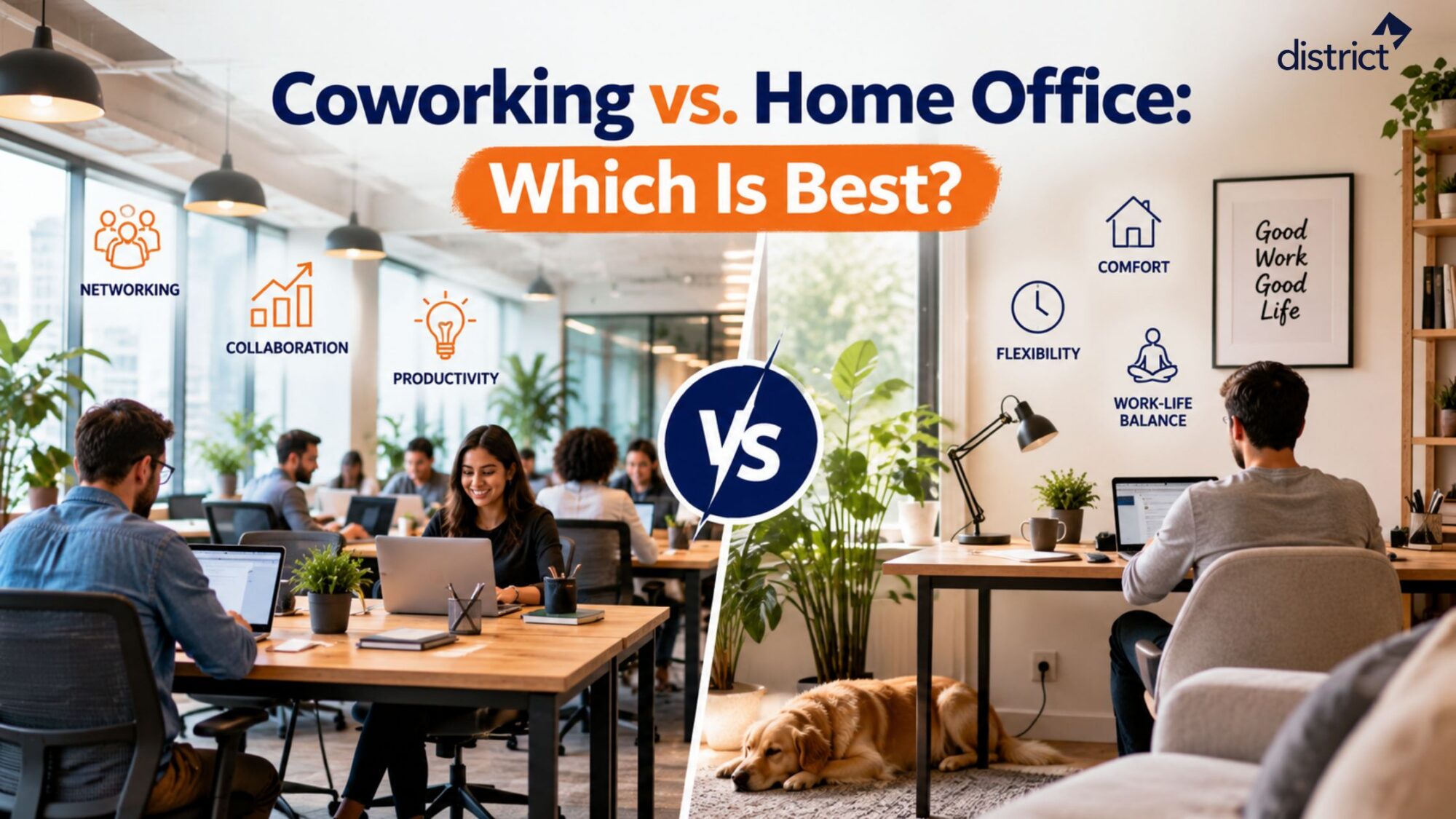
The way we work has changed dramatically. With remote work, freelancing, and flexible employment becoming increasingly common, professionals now have more choices than ever about where they work. Two of the most popular options are a home office and a coworking space.
Working from home offers comfort, flexibility, and zero commuting, while coworking spaces provide a professional environment, structure, networking, and a stronger separation between work and personal life. But which one actually helps you work better?
The answer depends on your work style, daily routine, need for collaboration, and ability to stay focused. In this guide, we’ll compare coworking spaces vs. home offices across productivity, cost, flexibility, distractions, networking, work-life balance, and overall experience to help you decide which workspace is the better fit for you.
Also Read: Dedicated Desk vs. Hot Desking: Which Is Right for You?
Coworking vs Home Office: What’s the Real Difference?
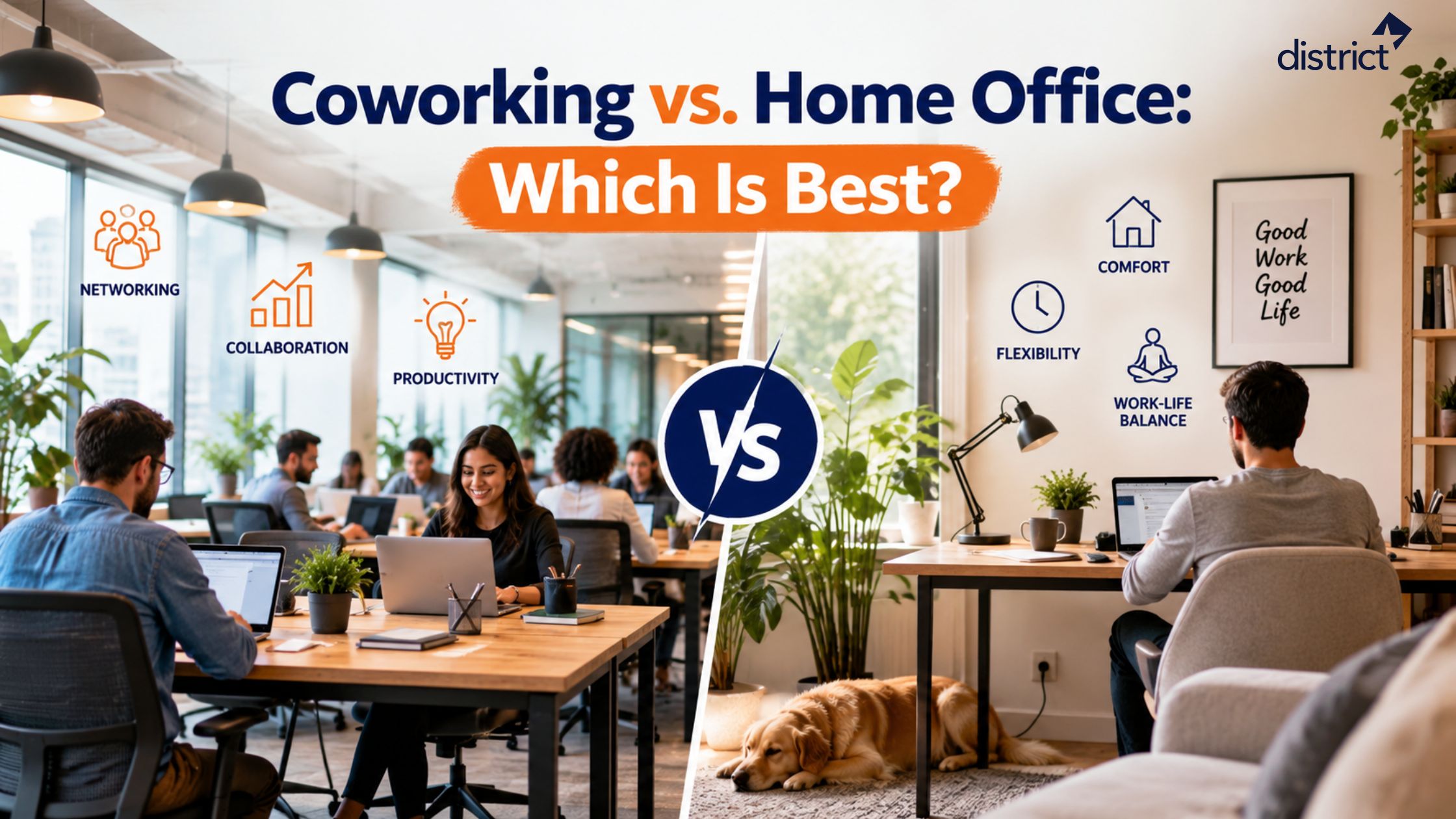
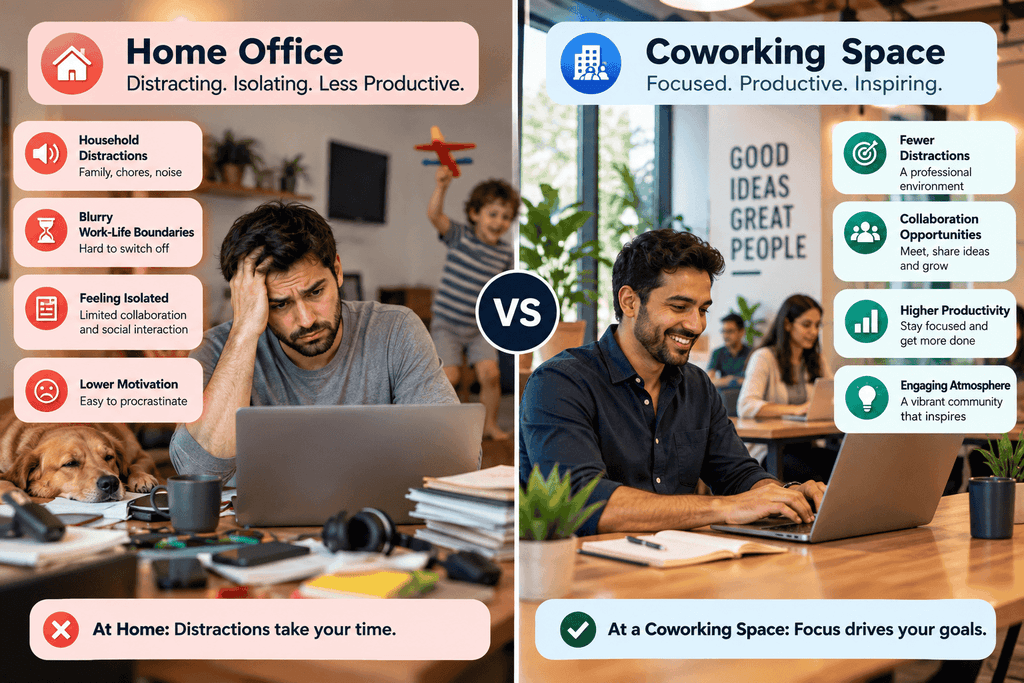
Working from home offers comfort and flexibility, but it can also come with distractions, household interruptions, isolation, and difficulty maintaining clear work-life boundaries. A coworking space, on the other hand, provides a professional environment designed to support focus, productivity, and collaboration.
With fewer distractions, reliable workspaces, networking opportunities, and an energetic community around you, coworking can make it easier to stay motivated and get more done. The real difference isn’t simply where you work; it’s how your environment influences your focus, mindset, and productivity.
Also Read: What Are the Benefits of Working From an Office? Complete Guide (2026)
What Is a Home Office?
A home office is a dedicated workspace within your home where you can manage your professional responsibilities without travelling to a traditional workplace. It can be as simple as a desk in a separate room or a more structured setup with an ergonomic chair, computer, monitor, storage, and other equipment needed for your work.
One of the biggest advantages of a home office is convenience. You can avoid commuting, create a workspace that suits your personal preferences, and enjoy greater flexibility throughout the day. For freelancers, remote employees, entrepreneurs, and small business owners, working from home can also reduce workplace costs and make it easier to manage personal commitments alongside work.
However, a home office also comes with challenges. Household chores, family interruptions, social media, television, noise, and other everyday distractions can make it difficult to maintain concentration. Because work and personal life happen in the same environment, some people may also find it harder to establish clear boundaries, stay motivated, or switch off at the end of the workday.
What Is a Coworking Space?
A coworking space is a shared professional workplace designed for people who want the benefits of an office without committing to a traditional corporate workspace. It brings together freelancers, entrepreneurs, remote employees, startups, small businesses, and even larger teams in a productive and professionally managed environment.
Most coworking spaces offer flexible seating options, dedicated desks, private offices, meeting and conference rooms, high-speed internet, printing facilities, breakout areas, and common spaces. Beyond the physical workspace, they also create opportunities for networking, collaboration, knowledge sharing, and building professional relationships.
One of the biggest advantages of coworking is the environment. Being surrounded by other focused professionals can create a stronger sense of motivation and accountability, making it easier to stay focused and avoid the distractions commonly associated with working from home. For remote workers and business owners, a coworking space can also provide a clear boundary between work and personal life while offering the flexibility to choose when and how they work.
Coworking vs Home Office: A Side-by-Side Comparison
| Factor | Home Office | Coworking Space |
| Monthly cost | No membership fee, but you cover furniture, internet, and utilities yourself. | Membership fee, usually all-inclusive of internet, coffee, and amenities |
| Commute | None | Short trip to a shared location |
| Distractions | Household chores, family, pets, deliveries | Mostly work-focused, though open areas can get noisy. |
| Networking | Limited to your existing contacts | Built-in exposure to other professionals and industries |
| Professional image | Video calls happen wherever your desk is | Access to proper meeting rooms for client-facing work |
| Structure | Entirely self-directed | Built-in start and end to the workday |
| Flexibility | Total control over your own schedule and setup | Often month-to-month, but tied to a shared space’s hours |
| Tax treatment | A home office deduction may apply for the self-employed. | Membership fees are typically a deductible business expense. |
Which Option Is Better for Productivity?
When it comes to productivity, the real question isn’t simply “Where can I work?” but “Where can I do my best work?” A home office gives you comfort and flexibility, but comfort can sometimes work against productivity. The same space where you answer emails may also be where you watch TV, handle household chores, take personal calls, or deal with unexpected interruptions. Over time, these small distractions can break concentration and make a simple task take much longer.
A coworking space creates a different psychological environment. When you enter a professional workspace, your brain gets a clear signal that it is “work time”. Being surrounded by other people who are working can also create a subtle sense of accountability and motivation. Instead of getting distracted by household activities, you are surrounded by an environment built around getting things done.
There is also the “productivity momentum” that comes from being around ambitious professionals. A quick conversation with another entrepreneur can spark an idea, a networking interaction can lead to a business opportunity, and a change of environment can sometimes help you approach a problem from a fresh perspective.
Another important factor is work-life separation. When your home is also your office, it can be difficult to truly disconnect. A coworking space gives you a physical boundary: you go to work, focus on work, and leave work behind when you walk out.
So, if you thrive on flexibility and have a naturally disciplined routine, a home office may be ideal. But if you want structure, fewer distractions, professional energy, networking opportunities, and a workspace designed for focus, coworking can offer a significant productivity advantage.
Which Option Is Better for Your Budget?
Cost comparisons here get misleading fast if you only look at the sticker price. A home office looks free because there is no invoice attached. Factor in a proper desk, a decent chair, faster internet, and the extra electricity from running the lights and HVAC at home all day. That “free” number climbs quickly.
A coworking membership is the opposite. It is a fixed, visible line item that is easy to budget around, even when it looks more expensive on paper than working from your kitchen table. For anyone self-employed, there is also a tax dimension worth understanding on both sides.
According to the IRS, self-employed workers who use part of their home regularly and exclusively for business may qualify for the home office deduction. This works through actual expenses or a simplified rate of $5 per square foot, capped at 300 square feet. Coworking membership fees are generally deductible as an ordinary cost of doing business, though the specifics are worth confirming with a tax professional.
Which Option Is Better for Networking and Professional Image?
Working from home puts a hard ceiling on who you interact with during the day. For most people, that ceiling is nobody outside their own household. That works fine for plenty of roles. But it quietly limits the kind of casual, low-stakes conversation that eventually turns into a referral or a first client.
Coworking spaces solve this almost without trying. You are seated near people from other companies and industries every day. Some of the most useful professional relationships start with nothing more than a shared coffee machine. There is a practical image benefit too. A client call from an actual meeting room looks very different from one taken from a couch with a pillow visible in the frame.
Which Option Is Better for Work-Life Balance?
A home office erodes the boundary between work and everything else almost by design. Your desk always sits a few steps from your couch. That proximity is exactly how one more email at nine at night turns into a habit rather than an exception.
A coworking space rebuilds that boundary. Physically leaving the building at the end of the day signals that the workday is over. Closing a laptop lid on your kitchen counter rarely carries the same weight. For anyone who genuinely struggles to switch off, that physical separation often matters more than any app built to enforce it.
Signs You Should Switch to a Coworking Space
A home office setup doesn’t work for everyone who has one. Consider a switch if:
- Client calls regularly get interrupted by household noise you cannot control
- You have gone more than a few weeks without a single in-person work conversation
- Your internet connection drops during calls more than once a month
- You find yourself working later into the evening simply because your desk is always within reach
- You need a professional room for client meetings and currently do not have one
Can You Get the Best of Both?
Plenty of people never have to choose one option permanently. A hybrid routine works well for many: home on quiet days, a coworking space for meetings or focused sprints. This captures most of the savings of a home office alongside the structure and networking a shared space provides.
That’s why most coworking providers sell flexible, month-to-month memberships instead of locking members into long contracts. Nothing about the decision has to be permanent. You can shift the balance to your workload, and your own focus levels change from one month to the next.
Which Workspace Actually Fits You?
Coworking vs. home office isn’t a question with one correct answer. It comes down to how much structure you need and how much your work depends on meeting people face-to-face. A quiet home and real self-discipline can make a home office work indefinitely. Constant distractions, isolation, or no professional place to meet a client are strong signs a shared space would serve you better.
If you are in Washington, DC, and want to test coworking without a long-term commitment, District Offices offers coworking spaces across four locations with flexible, month-to-month plans. Still deciding how much physical space your business needs? Our guide to flexible workspace solutions in Washington, DC breaks down private offices, coworking, virtual addresses, and hybrid plans side by side.
Frequently Asked Questions
A: For many freelancers, yes, particularly when isolation or household distractions are cutting into billable hours. The membership cost is usually offset by better focus and access to a real meeting room for client work.
A: Coworking membership fees are generally deductible as an ordinary business expense for self-employed workers. Confirm the specifics with a tax professional based on your situation.
A: To qualify, the IRS requires that you use a home office regularly and exclusively for business. Splitting time between a coworking space and a home office does not automatically disqualify you. The home portion of your setup still needs to meet that standard on its own.
A: It depends on the person. Research comparing the two found coworking spaces scored better on average for work-related and social measures. A genuinely quiet home paired with strong personal discipline can still hold its own.
A: Pricing varies widely by city and by the type of access you need, from a basic hot desk to a dedicated desk or private office. Most providers offer several tiers, so compare what’s included before assuming the cheapest option is the best value.