
Passive-aggressive behavior shows up as sarcasm, “forgotten” emails, silent treatment, and it can quickly drain a team. The APA Dictionary of Psychology describes it as behavior that seems innocuous, accidental, or neutral but indirectly displays an unconscious aggressive motive. In other words, the message is hidden inside the delivery. This guide shows you how to deal with passive-aggressive coworkers at work without making the conflict worse.
You will learn the signs of passive-aggressive behavior, why people use it, and nine practical ways to deal with passive-aggressive coworkers. It is a common form of workplace conflict, so a clear plan helps. You will also find sample phrases you can use today, a clear rule for when to involve HR, and the mistakes that make things worse.
What Does Passive Aggressive Behavior Look Like at Work?
Passive-aggressive behavior at work is an indirect way of showing anger, resentment, or resistance, and it is a quiet form of workplace conflict. Instead of saying “I disagree” or “I am upset,” the person shows it through tone, timing, and action. This makes it hard to confront, because they can always say they meant nothing by it.
The signs of passive-aggressive behavior are easy to miss on their own. However, a pattern is hard to ignore, and spotting it early helps you deal with passive-aggressive coworkers before resentment grows. Look for these common signs of passive-aggressive behavior:
- Sarcasm and backhanded compliments: A comment like “Great job, for a first try” sounds polite. However, it stings.
- The silent treatment: Instead of speaking up, the person upset goes quiet, skips greetings, or ignores messages.
- Agreeing, then not following through: Saying, “Sure, no problem” and then missing the deadline.
- “Forgetting” important things: Also, key emails, meeting invites, or handoffs somehow slip through.
- Talking behind your back: They share complaints with others instead of with you.
Still, a single bad day does not make someone passive-aggressive. Treat it as a pattern only after you see it repeat over weeks, not hours.
Why Do Coworkers Act Passive-Aggressive?
Most coworkers act passive-aggressive because they fear open conflict or feel they cannot speak up safely. Amy Gallo, a contributing editor at Harvard Business Review, notes that this behavior often stems from fear of conflict. She also says it’s a form of communication. Passive-aggressive behavior usually carries a real message, such as “I feel ignored” or “I disagree with this plan.”
Incentives matter too. Indeed, notes that people sometimes use passive aggression because it works for them. For example, coworkers competing for a promotion may turn to subtle digs or withheld help. Instead, ask what the person wants before deciding how to deal with a passive-aggressive colleague.
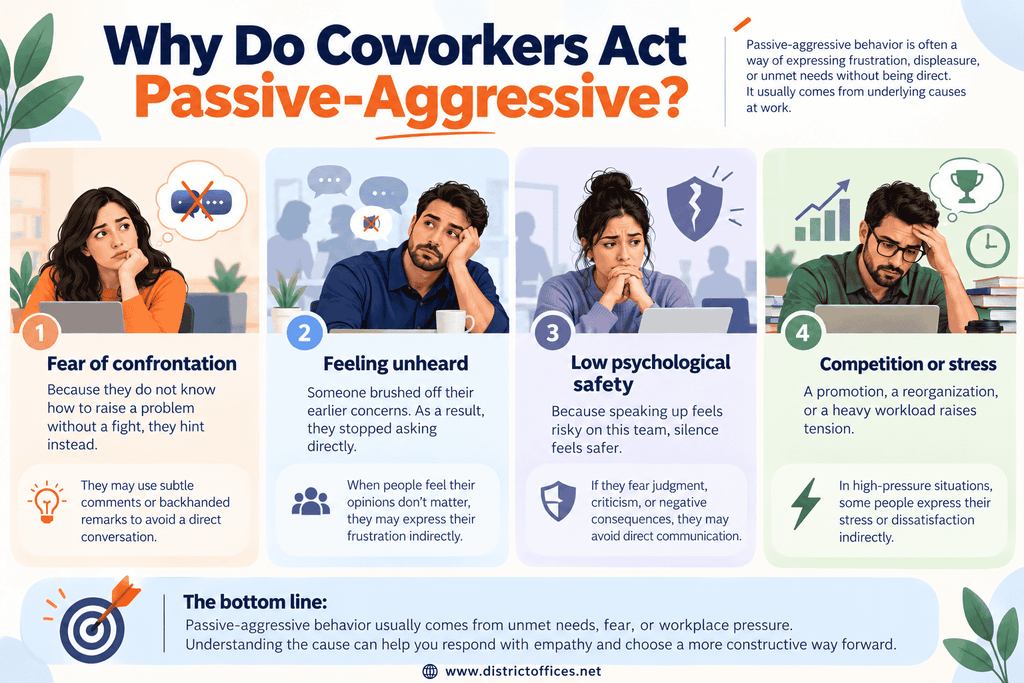
Common causes include:
- Fear of confrontation: Because they do not know how to raise a problem without a fight, they hint instead.
- Feeling unheard: Someone brushed off their earlier concerns. As a result, they stopped asking directly.
- Low psychological safety: Because speaking up feels risky on this team, silence feels safer.
- Competition or stress: Also, a promotion, a reorganization, or a heavy workload raises tension.
How Do You Deal with Passive Aggressive Coworkers? 9 Practical Ways
To deal with passive-aggressive coworkers, stay calm, look for the message behind the behavior, and then raise the issue directly and kindly. You cannot control how they communicate. Instead, focus on how you respond, because that often changes the whole dynamic and resolves workplace conflict early.
The nine ways below move from quick reactions to firmer steps. Start with the first four, which cost nothing and often solve small problems. Then use the later ones if the pattern continues.
1. Stay Calm and Do Not Match the Tone
When you deal with a passive-aggressive coworker, the first test is your own reaction. It is tempting to snap back or give them the silent treatment in return. However, Indeed studies warn that reciprocating keeps the unpleasant cycle going. Instead, take a breath, and process your frustration outside the conversation. Psychology Today also advises staying calm and composed so you can respond clearly.
2. Do Not Call It Passive Aggressive
Spotting the signs of passive-aggressive behavior is useful. However, labels feel satisfying but backfire. Gallo advises that accusing someone of being passive-aggressive makes things worse because they probably don’t see their behavior that way. HBR’s advice states: don’t accuse the person, because it will only make them angrier. Instead, describe what happened and how it affected the work.
3. Look for the Message Behind the Delivery
Ask yourself what the person is really trying to say. A snide remark about “another meeting” may mean “I am overloaded.” Once you spot the signs of passive-aggressive behavior, Indeed studies also suggest that separating the content from the delivery, because the person may be upset about a valid issue. Then respond to the content and let the tone go.
4. Check Your Own Part
Sometimes the behavior is a reaction to something you did. Gallo recommends asking whether you are contributing to the problem, and Indeed studies says that actions don’t justify the behavior, but you may still find something to own. If you do, apologize briefly. This also models the open communication you want to see.
5. Respond to the Words, Not the Tone
You can defuse many sarcastic digs with a short, neutral reply, and this keeps workplace conflict small. Gallo gives a simple example: if a coworker writes “Not sure if you saw my last email,” you can answer “Thanks for the reminder.” Keep it professional and brief. As a result, you refuse to play the game, and the moment passes. Boundaries also mean you do not have to answer every dig.
6. Make It Safe to Speak Directly
Passive-aggressive people often hold back because speaking up feels risky. Leadership expert Liane Davey suggests validating their concern first, then pointing them to the right forum. For example, say, “It sounds like there is something important beneath that comment. Can we talk about it?” This invites honesty without blame.
7. Have a Direct, Fact-Based Conversation
If the pattern continues, talk privately, for example in a private meeting room, and stay matter of fact. HBR advises recounting how past interactions played out, explaining the impact, and showing how the behavior works against something the person cares about, such as team goals. Gallo also suggests reviewing past behaviour like a referee, not a fan. Psychology Today adds that avoiding the words “you” and “your” can lower defensiveness. For example, try “When the report arrived late, the team missed its deadline. I would like to agree on a plan.”
8. Set Clear Expectations and Follow Up in Writing
Vague norms let passive-aggressive behavior thrive, and clear expectations help you deal with passive-aggressive coworkers fairly. Indeed recommends enforcing expectations equally across the team. Write down who does what by when and confirm it by email after meetings. Also keep a short record of concrete examples, as Zippia advises, so you can stay factual if you need to escalate.
9. Set Boundaries and Limit Contact
You don’t have to absorb everyone’s negativity. Zippia suggests limiting contact if nothing else works, and Nulab advises meeting in a group setting, where the person may behave less hostilely. Also, don’t let them speak for you, and don’t take on their tasks. Protecting your time is not rude. It is a healthy boundary, and it is the last step when dealing with passive-aggressive coworkers. For more on protecting your wellbeing, see these 10 ways to stay mentally strong at work.
What Should You Say to a Passive-Aggressive Coworker?
The best replies to a passive-aggressive coworker are short, calm, and curious. They respond to the message, not the tone, and they leave the door open for a direct talk. You do not need a perfect script. Instead, you need a steady voice and a plain question.
Here are sample replies for dealing with passive-aggressive coworkers; you can adapt them. They follow the advice above, and the first one comes from Gallo.
| What they say | A calm reply |
| “Not sure if you saw my last email.” | “Thanks for the reminder. I will reply today.” |
| “Fine. Whatever you think.” | “I want your real view. What would you do?” |
| “Great idea, for a first try.” | “What would make it stronger?” |
| “As I already said…” | “Let me confirm I have it right. Here is what I heard.” |
| “Sure, no problem.” (then no follow-through) | “Can we agree on a date? I will check in on Friday.” |
| Silence after a meeting | “I noticed you were quiet. Is there anything you wish you could say?” |
When Should You Involve a Manager or HR?
Involving a manager or HR before workplace conflict escalates, especially when the behavior continues after a direct, fact-based conversation, or when it harms deadlines, customers, or your well-being. Because a short list of dates and examples makes your case clear and fair, bring facts, not feelings. This rule applies whether you handle passive-aggressive coworkers as a peer or as a manager.
Some situations are more serious than passive aggression and require firm boundaries and a formal process. If the behavior involves threats, discrimination, or harassment tied to a protected trait, go to HR right away. Likewise, if the coworker is your manager, ask HR or a trusted leader how to raise it safely. In short:
- After a direct talk: Then escalate if the pattern continues even though you named the impact.
- When work suffers: Also escalate if deadlines, quality, or customers take a hit.
- For protected traits or threats: Escalate immediately, without trying to fix it alone.
- If you feel unsafe: Your health and wellbeing, come first.
What Mistakes Make Passive Aggressive Behavior Worse?
Most people make the same few mistakes when dealing with a passive-aggressive coworker. Because they react in the moment, the reaction rewards the behavior and prolongs the workplace conflict. Knowing the traps helps you avoid them. If the behavior turns into constant negativity, read how to handle toxic people at work.
Avoid these five mistakes when you deal with passive-aggressive coworkers:
- Calling them out publicly: An audience also makes people defensive. Instead, keep it private.
- Fighting fire with fire: Instead of matching them, stay neutral, because sarcasm back or the silent treatment only deepens the cycle.
- Venting to the team: Gossip also spreads the problem and damages your credibility.
- Ignoring the signs of passive-aggressive behavior for months: Because small digs build into resentment, act while it is small.
- Rescuing or nagging: Doing their work or chasing them daily therefore removes any reason to change.
Wrapping Up
To deal with passive-aggressive coworkers, stay calm, find the message behind the behavior, and then raise it directly and kindly. Keep your replies short, set clear expectations, and protect your boundaries. Once you recognize the signs of passive-aggressive behavior, a calm and curious response is usually enough to shift the pattern and resolve workplace conflict.
Start small this week. First, pick one comment you would normally ignore or snap at. Next, reply with a neutral question instead. Finally, if the pattern continues, book a private, fact-based talk. These steps give you a plan to handle passive-aggressive coworkers again and again. For the bigger picture, read how a positive company culture invigorates profitability and growth.
Frequently Asked Questions
Respond calmly to the words, not the tone. For example, answer “Not sure if you saw my email” with “Thanks for the reminder.” Then ask a plain, curious question that invites a direct answer.
Stay calm, avoid labeling the behavior, and look for the real concern underneath. Then raise the issue privately, using facts and the impact on the work. Set clear expectations and boundaries and then follow up in writing.
Common signs include sarcasm, backhanded compliments, the silent treatment, missed deadlines after saying yes, and complaining to others instead of to you. Also look for a pattern over time, not a single bad day.
Yes, but do it privately and calmly, and avoid accusing them of being passive-aggressive. Describe a specific event, explain its impact, and ask for their view. Instead of a confrontation, a direct, kind conversation works better, and it resolves workplace conflict faster.
Many who find themselves in this position fear conflict, feel unheard, or do not feel safe speaking up. Others use it because it gets results, like when they’re competing for a promotion. Understanding the motive helps you choose how to respond.
Stay with facts and skip the debate about intent. Say what you noticed, such as a missed handoff, and explain the impact on the work. Then agree on the next step and confirm it in writing so nothing depends on memory.
Report it when the behavior continues after a direct talk, harms your work or well-being, or involves threats, discrimination, or harassment. Also bring dates, examples, and keep your accounts factual.