Quick answer: A short-term office lease (usually 12 months or less) is better if your headcount, budget or plans may change soon, because it keeps cash free and lets you move or resize quickly. A long-term lease (typically five to ten years) is better for stable, established businesses that want lower rent per square foot, bigger landlord concessions and a fully customized space.
There’s no single right answer. The best choice depends on how predictable your next three to five years look, how much cash you want tied up, and how much control you need over the space. Demand for flexibility is clearly growing. In Q3 2026, 40% of Washington, DC office searches on TenantBase were for terms under one year, while 48% sought terms of three years or more. Nationally, flexible office inventory grew 18% year over year as of Q2 2026, per Cushman & Wakefield.
This guide compares both options on cost, risk, accounting and day-to-day practicality, so you can choose with confidence. If you’re new to flexible options, our overview of flexible workspace solutions in Washington, DC is a good starting point.
Table of Contents
ToggleWhat is the difference between a short-term and a long-term office lease?
The main difference is commitment. A short-term lease commits you for a few months up to about a year, often in a furnished, serviced space. A long-term lease commits you for several years, usually in raw or lightly finished space that you build out and manage.
What counts as a short-term office lease?
A short-term office lease generally runs from month-to-month up to 12 months, sometimes up to two or three years with flexible providers. Common forms include:
- Flexible or serviced private offices with furniture, internet and utilities included.
- Coworking memberships for hot desks or dedicated desks.
- Hybrid office plans that combine a private room with shared space.
- Short-term subleases of space another company no longer needs.
- Pop-up, project or swing space used during a move or renovation.
What counts as a long-term office lease?
A long-term lease is a traditional commercial lease directly with a building owner, typically lasting three to ten years or more. In Washington, DC, landlords often look for terms of five years or longer, and the most generous concessions in the market are tied to leases of five years or more, according to Cushman & Wakefield. The tenant usually designs the layout, arranges utilities and services, and is responsible for the space until the lease ends.
Short-term vs. long-term office lease: side-by-side comparison
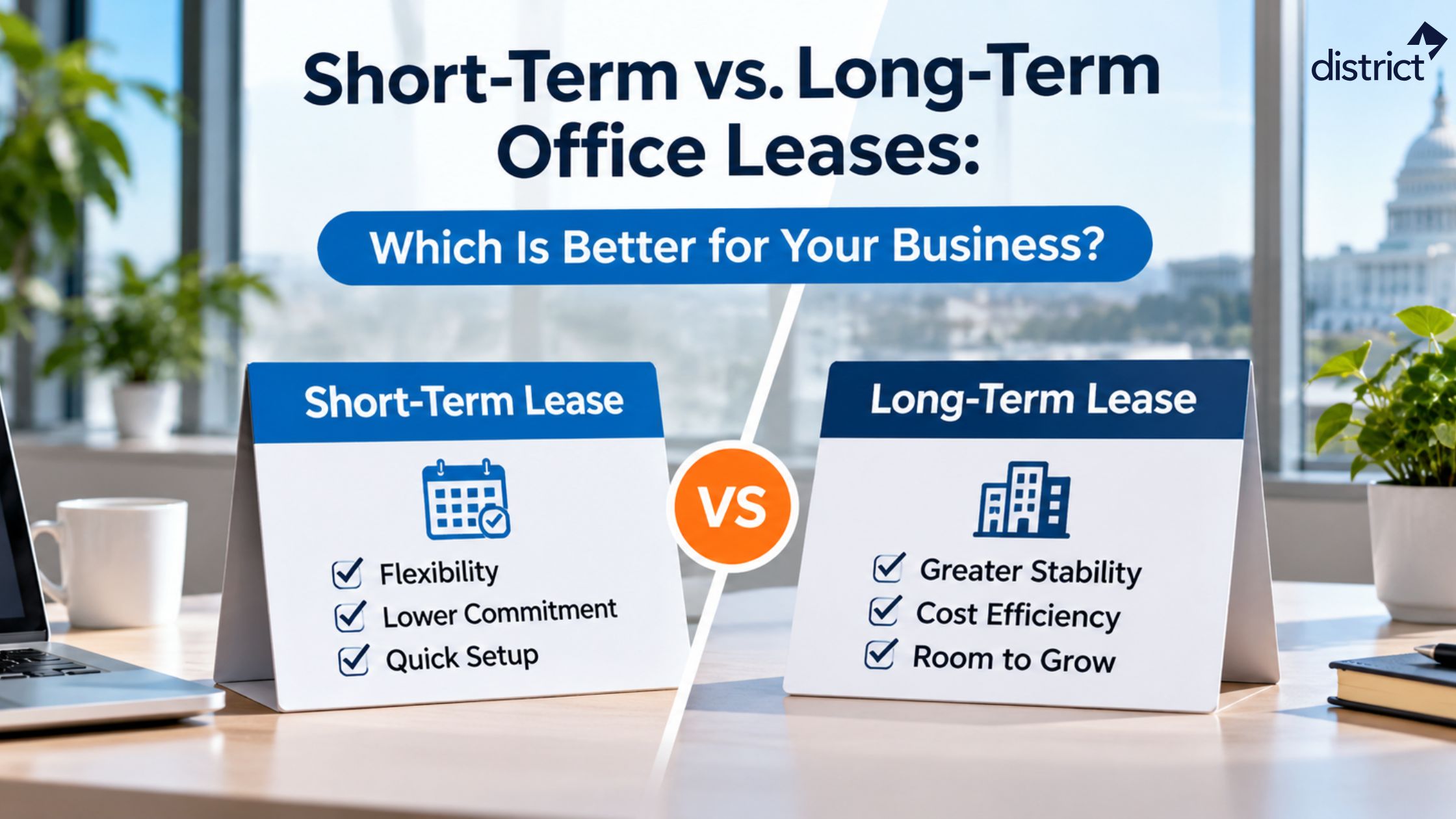
Short-term leases win on flexibility, speed and low upfront cost. Long-term leases win on price per square foot, control and stability.
| Factor | Short-term lease | Long-term lease |
| Typical term | Month-to-month to ~12 months | ~3 to 10+ years |
| Move-in time | Days | Weeks to months (design, build-out, permits) |
| Upfront cost | Low: deposit, possibly a setup fee | High: deposit, furniture, IT, build-out beyond allowances, legal fees |
| Monthly cost per square foot | Higher | Lower, especially after concessions |
| What’s included | Furniture, internet, utilities, cleaning, reception, meeting rooms | Usually just the space; services arranged by you |
| Landlord concessions | Few or none | Free rent and tenant improvement allowances on longer deals |
| Ability to resize | Easy to add or drop offices | Hard; needs expansion rights, sublease or buyout |
| Customization and branding | Limited | Full control |
| Exit risk | Low; short notice periods | High; you owe rent for the full term |
| Rent predictability | Rates may change at each renewal | Rent locked in, usually with set annual increases |
| Admin burden | Minimal; provider manages building services | Significant; you manage vendors, repairs within your space |
| Best for | Startups, small teams, hybrid schedules | Established firms with stable headcount and long-term plans |
What are the pros and cons of a short-term office lease?
Short-term leases trade a higher monthly rate for freedom: you can start fast, spend little upfront and leave or resize without a costly exit.
Advantages of a short-term lease
- Flexibility to grow or shrink. Add an office when you increase the size of your company or downsize if a contract ends. This is a big reason short-term office spaces suit startups.
- Low upfront cost. No furniture purchases, IT setup or build-out bills. Cash stays available for hiring and marketing.
- Fast move-in. Most fully furnished offices are ready within days.
- Predictable all-in bill. Utilities, cleaning, internet, and reception are included in one monthly payment.
- Access to shared amenities. Small teams have access to meeting rooms, kitchens and lounges they couldn’t justify building.
- Lower risk. If your business needs change, you aren’t tied to long-term rent commitment.
- Prime addresses within reach. A small office in a premium building costs far less. Here’s why a strong DC address matters.
Disadvantages of a short-term lease
- Higher cost per square foot. You pay for convenience and services, so per-square-foot pricing is usually higher than a long-term lease.
- Renewal uncertainty. Rates can rise at renewal, and a preferred office may not always be available.
- Limited customization. Branding, layout changes and specialized fit-outs are restricted.
- Shared environment. Common areas mean less control over noise and privacy; see common coworking space problems and fixes.
- Possible add-on fees. Extra meeting room hours, printing, parking and mail forwarding can raise the real monthly cost.
What are the pros and cons of a long-term office lease?
Long-term leases reward commitment with lower effective rent, landlord incentives and full control, but they lock you into years of payments whatever happens to your business.
Advantages of a long-term lease
- Lower rent per square foot. Landlords price longer commitments more attractively.
- Significant concessions. In Washington, DC, tenant improvement allowances averaged about $156 per square foot in Q3 2026, with roughly 1.7 months of free rent per year of term on leases over 10,000 square feet and five years or longer, per Cushman & Wakefield.
- Rent stability. Your base rent and annual increases are set in the lease, which helps long-range budgeting.
- Full customization. Design the layout, finishes, security and branding around your brand and workflow.
- Stable home base. Clients and employees know where you are for years; no renewal scramble every year.
Disadvantages of a long-term lease
- Big upfront investment. Even with allowances, you may pay for furniture, IT, cabling, moving and design work.
- Hard to exit. If you need less space, you usually remain liable for rent unless you sublease, negotiate a buyout or have a termination option.
- Slow to adapt. Growth beyond your footprint may require a second location or an early move.
- More to manage. You arrange internet, cleaning, supplies and in-suite repairs, and you carry more administrative work.
- Risk of paying for empty space. With hybrid work, many companies find they lease more desks than they use day to day; see our guide to office space challenges small businesses face.
Which costs less: a short-term or a long-term office lease?
On a price-per-square-foot basis, a long-term lease is usually cheaper. On a total-cost basis for small teams, a short-term flexible office is often cheaper, because furniture, internet, cleaning and setup are bundled in and you don’t pay for space you aren’t using.
Example: a five-person team in Washington, DC over three years
| Cost item | Long-term lease (~1,000 SF, Class C to Class A) | Short-term flexible office (5 desks) |
| Rent or membership | ~$135,000 to $186,000 | ~$86,000 to $146,000 |
| Furniture | ~$5,000+ upfront | Included |
| Business internet | ~$7,000 to $32,000 | Included |
| Cleaning, reception, meeting rooms | Extra or self-managed | Usually included |
| Estimated three-year total | ~$147,000 to $223,000+ | ~$86,000 to $146,000+ |
How the estimate works: the lease column applies the DC asking-rent range of roughly $45 to $62 per square foot per year (Class C to Class A, per Cushman & Wakefield Q3 2026) to 1,000 square feet for three years, plus furniture and internet ranges from Workbox. The flexible column uses about $480 to $810 per desk per month, based on Farragut Square listings on Hubble. Concessions, parking, deposits and build-out beyond allowances are excluded. Treat this as a framework, not a quote.
When the math flips toward a long-term lease
The gap narrows, and can reverse, as your team and term grow. Larger tenants signing for five to ten years can negotiate months of free rent and substantial build-out money, which lowers the effective rent well below the asking rate. For a stable team of 20 or more, a long-term lease often delivers the lowest cost per person.
Hidden costs to include in any comparison
- Security deposits and, for newer businesses, larger deposits or letters of credit
- Build-out costs above the landlord’s allowance
- Annual rent escalations and pass-through of operating expenses or taxes
- Moving, IT setup and furniture installation
- Extra fees in flexible offices: meeting rooms beyond allowance, printing, parking, mail forwarding
For more ways to control overhead, see our business expense reduction guide.
How do lease length, accounting and risk affect your business?
Lease length changes more than rent. It affects your balance sheet, your personal exposure and how easily you can respond to change.
Balance sheet impact (ASC 842)
Under the U.S. lease accounting standard ASC 842, companies must generally record leases longer than 12 months on the balance sheet as a right-of-use asset and a matching lease liability. Leases of 12 months or less, with no purchase option the tenant is reasonably certain to exercise, can qualify for a short-term exemption and stay off the balance sheet, according to guidance summarized by KPMG.
Why it matters: a large long-term lease liability can affect loan covenants, debt ratios and how lenders or investors view your company. Renewal options and auto-renewals can change whether a lease counts as short-term, so check with your accountant before signing. This is general information, not accounting or legal advice.
Personal guarantees and liability
Landlords often ask small or young businesses for a personal guarantee on a long-term lease. That can make the owner personally responsible for years of rent if the business struggles. Short-term flexible agreements usually carry far less exposure, though deposits and notice terms still apply.
Business risks to weigh
| Risk | Short-term lease | Long-term lease |
| Business slows or a contract ends | Reduce space or leave at the next term | Rent still owed; sublease or negotiate |
| Rapid growth | Add offices or desks quickly | May outgrow the space before the lease ends |
| Rent increases | Exposure at each renewal | Locked in, with set annual increases |
| Return-to-office uncertainty | Adjust desks as attendance changes | Risk of paying for empty desks |
| Landlord or building issues | Provider handles most problems | Depends on lease terms and landlord responsiveness |
Which lease is right for your business?
Choose short-term if your next two years are uncertain; choose long-term if they’re predictable and you want the lowest cost per person. The table below matches common business types to the option that usually fits best.
| Business type | Usually better fit | Why |
| Freelancer or self-employed professional | Short-term (coworking or small private office) | Low cost, no long commitment |
| Startup or early-stage company | Short-term | Headcount and funding can change quickly |
| Small business (2–15 people) | Short-term or short traditional lease | Flexibility usually beats per-SF savings at this size |
| Mid-sized, stable business (20+ people) | Long-term | Concessions and lower rent outweigh flexibility |
| Government contractor | Short-term for new contracts; long-term for multi-year awards | Match space to contract length; see workspace for government contractors |
| NGO or nonprofit | Short-term or flexible | Aligns costs with grant and funding cycles |
| Out-of-town or expanding company | Short-term or virtual office first | Test the market before committing |
| Corporate team or satellite office | Short-term private suite | Fast setup without a long lease; see private offices for corporate teams |
| Business with specialized build-out needs | Long-term | Custom labs, secure rooms or heavy IT need a long horizon |
Seven questions to help you decide
- How confident are you about headcount 12, 24 and 36 months from now?
- How much cash can you set aside for furniture, IT and build-out?
- Do you need a custom layout, secure rooms or strong branding?
- How often will your team be in the office each week?
- Would a personal guarantee or balance-sheet liability be a problem?
- Do you need to be in a specific neighborhood, such as Capitol Hill or Farragut Square?
- How quickly do you need to move in?
If most answers point to uncertainty, speed or limited cash, start short-term. If they point to stability, custom needs and a long horizon, a long-term lease is likely the better value.
Is there a middle ground between short-term and long-term leases?
Yes. Many businesses no longer choose one or the other; they combine options or negotiate flexibility into a longer lease.
Hybrid real estate strategies
- Core and flex: Keep a smaller long-term office for your core team and use flexible offices or coworking for overflow, project teams or new hires.
- Hub and satellite: Lease a headquarters elsewhere and add a short-term private office in DC for client and government meetings.
- Virtual plus on-demand: Use a virtual office for your address and mail, and book meeting rooms only when you need them.
- Hybrid office plans: A private room for regular use plus shared space for teammates who come in part time.
Flexibility clauses to negotiate in a long-term lease
- Early termination option: The right to exit after a set period, usually with a fee.
- Expansion or right of first refusal: Priority on nearby space if you grow.
- Contraction option: The right to give back part of the space.
- Sublease and assignment rights: Permission to sublet or transfer if your needs change.
- Renewal options: The right to extend at a defined rent or market rate.
- Shorter initial term: Three years instead of five or ten, accepting smaller concessions.
A tenant broker or real estate attorney can help you weigh these clauses against the rent and incentives on offer.
A practical path many small businesses follow
Start in a short-term private office while the team is small and plans are fluid. Once headcount is stable for a year or two and you know how often people come in, revisit the numbers. At that point a longer lease, or a larger flexible suite, can be chosen based on real usage instead of guesses.
Frequently Asked Questions
A short-term office lease usually runs from month-to-month up to 12 months. Some flexible providers offer agreements of two to three years that still include furniture and services.
Most long-term office leases run three to ten years. In markets like Washington, DC, five years or more is common, and the biggest landlord incentives are tied to longer terms.
Per square foot, usually yes. But for small teams, the total cost is often lower because furniture, internet, utilities and cleaning are included and no build-out is needed.
Only if the lease allows it or the landlord agrees. Common routes are an early termination clause, subleasing, assigning the lease or negotiating a buyout. Review the lease with an attorney before signing.
Under ASC 842, leases of 12 months or less without a likely purchase option can qualify for a short-term exemption and stay off the balance sheet. Renewal options can change that, so confirm with your accountant.
Usually, yes. Startups benefit from low upfront costs and the ability to add or drop space as funding and headcount change. Read more about how short-term office spaces help startups.
Only if you’re confident in your space needs for the full term. Lower rent doesn’t help if you end up paying for desks nobody uses or moving out early.